


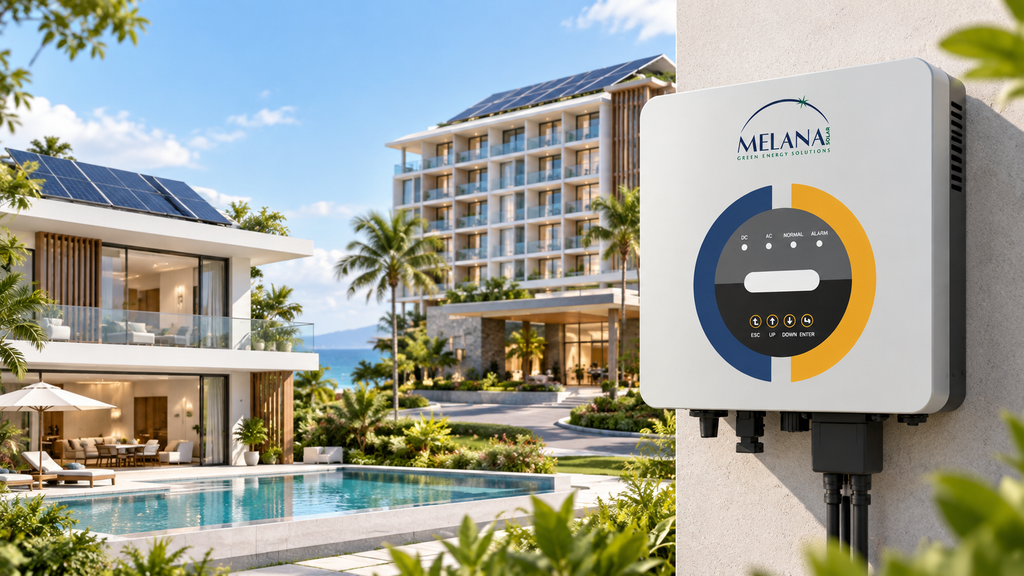
For villas and hotels, producing solar electricity is only one part of managing energy efficiently. Solar inverters convert DC electricity from solar panels into usable AC electricity. When correctly sized and, where applicable, paired with load-management or storage controls they can help supply heavy daytime loads.
A hybrid solar inverter offers additional flexibility by coordinating solar panels, batteries, utility power, and compatible generators. Melana Solar helps villas and hotels design systems around their actual energy use instead of simply choosing equipment based on advertised capacity.
Why Large Daytime Loads Matter for Villas and Hotels
Hotels and large villas often consume significant electricity during daylight hours. Air conditioning, pool pumps, water systems, refrigeration, kitchens, lighting, and guest-room appliances may operate at the same time.
This creates an excellent opportunity to use solar Inverters energy directly. Electricity produced during the day can immediately supply active equipment instead of depending entirely on the grid.
Direct solar consumption can also reduce unnecessary energy conversion and battery cycling. For many hospitality properties, matching solar production with daytime demand can improve overall system efficiency.
Why a Hybrid Solar Inverter Works Well
A hybrid inverter can manage several energy sources within one system. It can prioritize solar electricity for active loads and send excess production to batteries when storage is available.
When solar generation becomes lower, battery energy can support selected equipment. Grid electricity can provide additional support when required. On hybrid inverters designed for generator input, a compatible generator can also provide backup and/or charge batteries.
This flexibility can be especially valuable for hotels and villas where uninterrupted electricity is important. It can also help property owners control how and when different energy sources are used.
However, a larger battery is not always automatically better. Properties with strong daytime demand may consume much of their solar production directly without storing every available kilowatt-hour.
Sizing Solar Inverters for Villas and Hotels
For hybrid or backup systems, inverter output sizing should consider simultaneous electrical load, peak demand and surge requirements. PV-side inverter sizing must also consider the
solar array’s DC capacity, inverter DC/AC ratio, voltage and current limits, and grid requirements.
The designer should understand both normal demand and short periods of higher demand.
| Factor | Why It Matters |
| Daytime load | Shows normal inverter demand |
| Peak load | Identifies periods of maximum usage |
| Motor surge | Covers HVAC and pump startup |
| Battery capacity | Determines available stored energy and approximate backup duration |
Start With the Daytime Load Profile
A load profile shows when and how a property uses electricity. It can identify periods when air conditioning, kitchen equipment, pumps, and other appliances operate simultaneously.
This information helps designers match inverter capacity and solar production more accurately. It also reduces the risk of choosing equipment that is unnecessarily large or too small.
Account for Peaks and Motor Surges
Some hotel equipment requires extra power for a few seconds when starting. Pumps, compressors, refrigeration equipment, and certain air-conditioning systems are common examples.
The inverter should therefore handle both continuous loads and short-duration surge loads. Large hospitality properties may also need proper three-phase design and phase balancing.
Solar Systems in the British Virgin Islands, Mexico, and Colombia
Location can significantly influence system design. Climate, humidity, temperature, electricity supply, local regulations, and property usage patterns should all be considered.
In the British Virgin Islands, coastal villas and hotels may experience high humidity, heat, and salt exposure. Inverter placement, ventilation, enclosure protection, and corrosion resistance can therefore be important considerations.
In Mexico, operating conditions can vary greatly between coastal resorts, inland cities, and hotter regions. Solar-system design should account for local temperatures, available roof space, energy tariffs, and property demand.
Colombia also has very different climates depending on location and elevation. A coastal hotel may have heavy air-conditioning demand, while properties in cooler regions may have very different daytime load profiles.
For this reason, one standard inverter configuration should not be used for every property. Each system should be designed around the actual site.
Immediately
It means matching inverter capacity immediately with actual daytime loads, peak demand, and future energy requirements.
Choosing the Right Solar Inverter System
Villa and hotel owners should compare more than inverter capacity. Continuous output, surge capability, solar input limits, battery compatibility, operating temperature, monitoring, warranty support, and phase requirements should also be considered.
Future expansion is another important factor. A hotel may later add rooms, electric vehicle chargers, new air-conditioning units, kitchen equipment, or additional recreational facilities.
Allowing reasonable room for expansion can make future upgrades easier. It can also prevent costly electrical redesign when the property’s energy requirements increase.
Melana Solar can help property owners evaluate these factors before selecting their solar equipment. The goal is to create a balanced system where the panels, inverter, batteries, and electrical loads work together efficiently.
Solar Inverters for Smarter Villa and Hotel Energy Use
Well-designed Solar Inverters can help villas and hotels use more solar electricity during periods of high daytime demand. Proper sizing and load management can also improve reliability and reduce dependence on grid electricity or generators.
A carefully selected hybrid system adds even more flexibility. The best results come from designing the entire solar system around the property’s real energy requirements.
Frequently Asked Questions
Q1: What size solar inverter does a hotel need?
Answer: The correct size depends on simultaneous electrical loads, peak demand, motor surges, solar-panel capacity, and future expansion. The number of hotel rooms alone is not enough to determine inverter size.
Q2: Is a hybrid solar inverter suitable for a villa?
Answer: Yes. A hybrid system can combine solar generation, batteries, grid electricity, and compatible backup power to provide both energy savings and greater flexibility.
Q3: Can solar power run hotel air conditioning during the day?
Answer: Yes, when the solar panels and inverter are properly sized. Air conditioning can be a strong daytime solar load because cooling demand often overlaps with high solar production.
Q4: Do hotels need batteries with their solar system?
Answer: Not always. Hotels with heavy daytime energy use may consume a large percentage of solar production directly, while batteries become more useful for evening consumption and backup requirements.
Q5: What should coastal hotels consider when choosing solar inverters?
Answer: Coastal properties should consider heat, humidity, salt exposure, enclosure protection, ventilation, corrosion resistance, monitoring, and warranty support. Proper installation location can also help protect inverter performance and lifespan.