


Running an air conditioner, refrigerator, water pump and other household appliances on the same electrical system requires careful inverter selection. An inverter that works well for basic lighting and electronics may not be suitable for a home with several power-hungry appliances.
Choosing the right solar inverter involves more than checking its advertised wattage. Continuous power output, starting requirements, battery compatibility and household electricity consumption all play an important role. Melana Solar offers different smart solar inverter solutions for residential and larger applications, making it important to select a configuration that matches the property’s actual power requirements.
Why Choosing the Right Inverter Capacity Matters
Every household appliance consumes electricity differently. While a television or LED light has relatively predictable power requirements, appliances with motors and compressors can demand additional power when starting.
An air conditioner, refrigerator, or water pump may temporarily draw more electricity during startup than it uses during normal operation. This is why an inverter must be selected according to both the running load and the starting requirements of connected appliances.
Running Watts vs Starting Watts
Running watts refer to the electricity an appliance consumes during normal operation. Starting watts refer to the additional power that some appliances require when their motors or compressors start.
For example, a refrigerator may operate with relatively low power consumption but require a higher initial surge when its compressor starts. Similarly, an air conditioner can place additional demands on an inverter during startup, depending on its compressor and control technology.
Ignoring these requirements can result in inverter overloads, unexpected shutdowns, or unreliable appliance operation.
How to Calculate the Right Solar Inverter Capacity for Your Home
Before purchasing a solar inverter for heavy loads, prepare a list of appliances you intend to operate simultaneously. Check their rated power consumption from the manufacturer’s labels or technical specifications.
Add the running wattage of these appliances to estimate the total operating load. You should then account for starting power, particularly for refrigerators, pumps and air conditioners.
Consider this illustrative example of a household:
| Household appliance | Estimated running power |
| 1.5-ton air conditioner | 1,500 W |
| Refrigerator | 200 W |
| Water pump | 750 W |
| Television | 120 W |
| LED lighting | 150 W |
| Total running load | 2,720 W |
In this example, the combined running load is approximately 2.72 kW. However, selecting an inverter rated at exactly 2.72 kW would not necessarily be sufficient.
Starting requirements, simultaneous appliance operation, inverter surge capability and appropriate operating headroom must also be considered. The actual figures will vary depending on appliance models and operating conditions.
Which Type of Solar Inverter Is Suitable for Your Home?
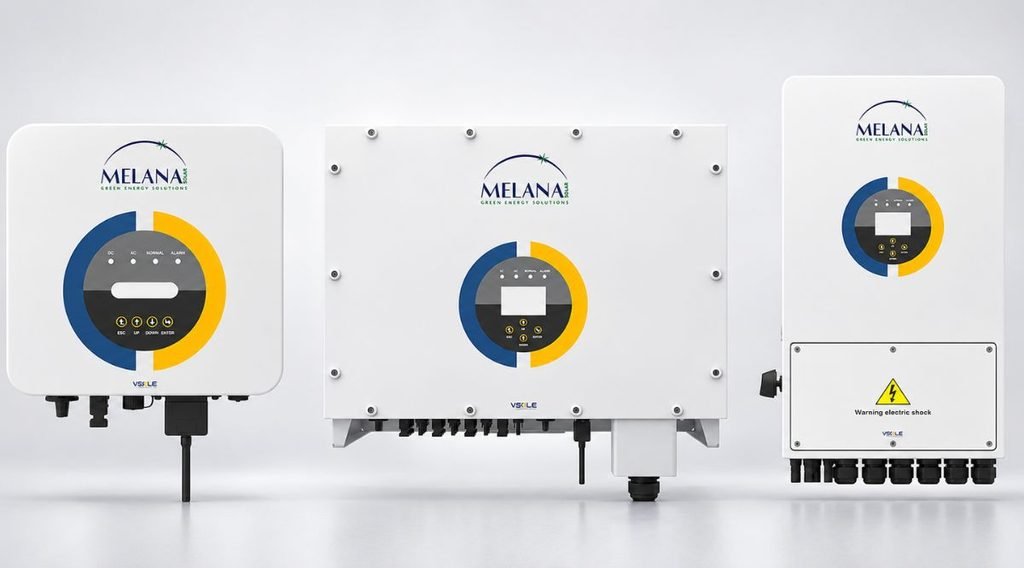
Not every property has the same electricity requirements. A small residential installation may need a different inverter arrangement from a large home with multiple air conditioners or a commercial property.
Melana Solar’s smart inverter range includes different configurations for residential, commercial, and energy management applications.
Single-Phase Grid-Tie Inverters for Residential Applications
Single-phase grid-tie inverters are commonly used in residential solar installations where the property has a compatible single-phase electrical connection.
They convert electricity generated by solar panels into usable AC electricity for the connected electrical system. Their suitability depends on inverter capacity, household consumption and the property’s grid connection.
A standard grid-tie inverter generally shuts down during a grid outage unless the installation includes a separate backup arrangement designed for that purpose.
Hybrid Inverters for Flexible Energy Management
Hybrid solar inverters combine solar generation with other available power sources and, depending on the model, battery storage.
They can be suitable for homes that want to use solar electricity while maintaining additional power options. Battery compatibility, output capacity and backup functionality should be checked before selecting a particular model.
Three-Phase Inverters for Larger Properties
Larger homes and properties with three-phase electrical connections may require three-phase inverter configurations.
These systems are relevant where electricity demand is distributed across multiple phases or where larger residential and commercial installations require higher power capacities.
All-in-One Inverters and Integrated Battery Solutions
All-in-one systems combine multiple power management components within an integrated arrangement. Depending on the model, these solutions can simplify system design and provide coordinated solar and battery management.
Melana Solar’s product range also includes microinverters, zero-export devices and LFP battery solutions for different solar energy applications.
5 Important Features to Check Before Buying a Solar Inverter
The inverter’s capacity is only one part of the selection process. Several other specifications influence how reliably it can operate household appliances.
- Continuous output and surge capacity: Check the inverter’s rated output and how much additional power it can supply during short startup periods.
- Pure sine wave output: A pure sine wave output is generally suitable for modern household electronics, appliances and motor-driven equipment, provided the electrical specifications are compatible.
- MPPT solar charging technology: Maximum Power Point Tracking helps solar inverters optimise the electrical power collected from connected solar panels.
- Battery compatibility: Check the supported battery chemistry, voltage range, charging requirements, and communication compatibility before connecting a battery.
- Overload and temperature protection: Appropriate protection mechanisms help safeguard equipment against excessive electrical loads and operating temperatures.
Common Mistakes When Choosing a Solar Inverter
One common mistake is purchasing an inverter based only on the combined running wattage of household appliances. This overlooks the additional power some appliances require during startup.
Another is choosing a system without considering future electricity requirements. Adding another air conditioner, water pump or refrigerator later can increase the household load beyond the inverter’s available capacity.
Battery compatibility is equally important for homeowners planning to include energy storage. The inverter and battery must support compatible electrical and communication specifications.
Why Consider Melana Solar Smart Solar Inverters?
Melana Solar offers a range of smart solar inverter solutions designed for different residential, commercial and industrial applications.
The product portfolio includes single-phase and three-phase grid-tie inverters, hybrid inverters, microinverters, all-in-one systems and zero-export devices. Melana Solar also offers LFP battery solutions for energy storage applications.
This range provides different options for properties with varying electricity requirements. The right selection depends on appliance loads, electrical connections, solar panel configuration and backup expectations.
Rather than choosing an inverter simply because it has a higher capacity, homeowners should assess their actual power consumption and select a system that suits their requirements.
Choosing an Inverter That Fits Your Home
A suitable solar inverter should support your household’s current appliance requirements while allowing room for practical future needs. Pay attention to running loads, starting power, electrical configuration and battery compatibility before making a decision.
With its range of smart solar inverter solutions, Melana Solar caters to different residential and commercial energy requirements. Selecting the right configuration is the first step towards a dependable solar power system.
Frequently Asked Questions
Q1. Can one solar inverter power an entire house?
Answer: Yes, provided its output capacity, electrical configuration and available energy supply are sufficient for the appliances operating simultaneously. Larger homes may require higher-capacity or three-phase systems.
Q2. Is a three-phase inverter necessary for a large home?
Answer: Not always. It depends on the property’s electrical connection, total power requirements and load distribution. A qualified installer can assess whether a single-phase or three-phase configuration is appropriate.
Q3. Why does an inverter trip when multiple appliances are running?
Answer: This can happen when the combined electrical load exceeds the inverter’s rated capacity or when appliances demand more starting power than the inverter can supply.
Q4. Can I add more solar panels to my existing inverter?
Answer: It depends on the inverter’s maximum PV input power, voltage range, current limits and available MPPT inputs. Additional panels must remain within the manufacturer’s permitted specifications.
Q5. Does an inverter need a battery to operate?
Answer: Not necessarily. Grid-tied solar inverters generally operate without batteries. Hybrid and off-grid configurations have different battery requirements depending on their design and intended operation.